Glasgow University Exploration Society
The Neil Mackenzie trust: Tobago Grant Summary
From Cate Wynn, One of The Co-Leaders of The Tobago Expedition, Glasgow University Exploration Society 2024.
Projects
The recent research expedition to Tobago, generously supported in part by the Neil Mackenzie Trust, was a unique opportunity for us to conduct valuable animal-based research while gaining life-changing hands-on experience that will benefit not only our academic careers but also our personal development.
Our research focused on investigating the abundance and diversity of various species across different habitat types, including reptiles, amphibians, butterflies, moths and other terrestrial invertebrates. Additionally, we studied the fascinating behaviour of motmots, specifically their use of anvils to break open hard-shelled prey, to gain a deeper understanding of how this behaviour is learned and utilized. The funding from the Neil Mackenzie Trust was instrumental in covering the costs of essential equipment and travel expenses, making the expedition possible.
Research Methods and Project Details
Throughout the expedition, we undertook several projects that centred on comparing species abundance and diversity across different habitats, such as Lower Montane forests, Secondary Deciduous forests, and Lowland Rainforests. Below is a breakdown of the key methods used for each project:
Herpetology Project (Reptiles and Amphibians)
We utilized pitfall traps to capture reptiles and amphibians. These are simple but effective traps where plastic buckets are buried into the ground with their rims level with the surface. A guide fence is placed between the buckets to funnel animals toward the traps. In each forest type, the traps were spaced 5 meters apart. We also conducted 500m transect observation surveys, where we walked a set path in each habitat, recording sightings of reptiles and amphibians to further compare species across different environments.
Butterfly Project
Southern Red Rim (Biblis hyperia) – butterfly found resting under a leaf (Taken in Tobago, August 2024)

This involved hanging baited traps in differing habitat to attract butterflies. These traps contained fermented fruit or other baits like rotten fish;0 to lure butterflies, which we would later identify using field guides. Additionally, we carried out 500m transect surveys similar to the herpetology project, recording butterfly species observed along set paths in each forest type.
Moth Project
We set up LED light traps at night to attract moths. The moths are drawn to the light, and after allowing time for the moths to gather we would capture, observe and identify the different moths and then freed them.
Some of the team hanging on of the moth traps ready to capture lots of moths!:) (Taken in Tobago, August 2024).

Terrestrial Invertebrate Project
For invertebrates, we used pitfall traps similar to those in the herpetology study, as well as a method called tree beating. This involves placing a large, open umbrella beneath a tree or bush, then gently shaking the branches to dislodge any invertebrates, which fall into the umbrella for collection and identification.
Motmot Behavioural Study
The motmot study focused on anvil use, where these birds use hard surfaces to break open prey like beetles. We located several anvil sites (usually rocks or tree stumps) and set up trail cameras to record their behaviour. We also conducted early morning field observations, as this is when motmots are most active, to gather real-time data on their behaviour in different habitats.
In addition to our fieldwork, we engaged with the local community by giving a talk at the Charlotteville library, where we shared our research aims and findings with the public. This interaction was a great way to connect with the local people and raise awareness about the importance of biodiversity and conservation.
Our efforts revealed notable correlations between species abundance, diversity, and the habitats in which we conducted our sampling. For instance, certain species of reptiles and invertebrates were more prevalent in specific forest types, underscoring the importance of habitat conservation. We are still analysing all our data and so in the coming months we will have more detailed results! Additionally, we collected a significant amount of video footage on motmot anvil use, which adds to the body of knowledge on avian behaviour and has the potential to inform future studies on the species. This data will contribute to a broader understanding of Tobago’s fauna, and we hope it will aid future research efforts, particularly in conservation planning. We plan to share our findings with the University of the West Indies (UWI) and the University of Glasgow, with the hope that this research will be built upon in future projects.
The Team’s Personal Experience
A picture of the whole team! (Taken in Pigeon Point in Tobago August 2024).First row left to right: Oliver Fowler, Cate Wynn, Gabriel Hodgkin, Louis Adams, Leila Cooper, Evie Dwyer, Grace SavageSecond row left to right: Evan Williams, Simon Dalton Celis, Tara Palka

Our team of 10 students gained both academically and personally from this expedition. Conducting fieldwork in unfamiliar environments built our confidence and taught us the importance of flexibility and resilience in scientific research. Whether it was adapting to the intense heat, navigating difficult terrain, or collaborating as a team, we all grew in ways we hadn’t anticipated.
For many of us, this was the first time spending such an extended period away from home, and the experience was transformative. Living and working in Tobago for nine weeks gave us the chance to immerse ourselves in the local culture, forge lifelong friendships, and gain perspectives that will shape our future careers and lives. As cliché as it sounds, we learned that the world is much bigger than we had previously known and that there are endless opportunities for growth, exploration, and learning outside our comfort zones.
Our Biggest Thanks
The Neil Mackenzie Trust played a crucial role in making this expedition possible. By funding a portion of the expedition, the trust allowed us to fully focus on our research, knowing we had the support of a wider community that believed in the value of our work. This trust sponsorship gave our expedition added significance, connecting it to a legacy of outdoor adventure, exploration, and learning, all in honour of Neil Mackenzie.
We are deeply grateful for this support, which made this invaluable experience possible. It has inspired us to honour the values of the trust by making the most of every opportunity to expand our knowledge and contribute to the scientific community.
We will be forever grateful for your generosity J
A mixture of Images attached from the expedition (to be added in due course.)

Glass frog at nighttime found under a leaf with its eggs (Taken in the Main Ridge Forest in Tobago August, 2024).
.
One of the team is captured using his camera mid-shot, focusing on a scenic view, when a hummingbird unexpectedly flies into the frame, hovering just in front of the camera lens. Hummingbird is a White-tailed Sabrewing (Taken in Tobago, August 2024).

Picture of some of the team playing maracas a at a local steel drum band performance. It was very cool, we had never been to anything like it – they were playing popular classic songs using the steel drums! (taken in Castara Tobago, July 2024)

Some of the group snorkelling to see the beautiful coral reef and all its inhabitants that surrounds Tobago (Taken just off of Little Tobago August 2024).
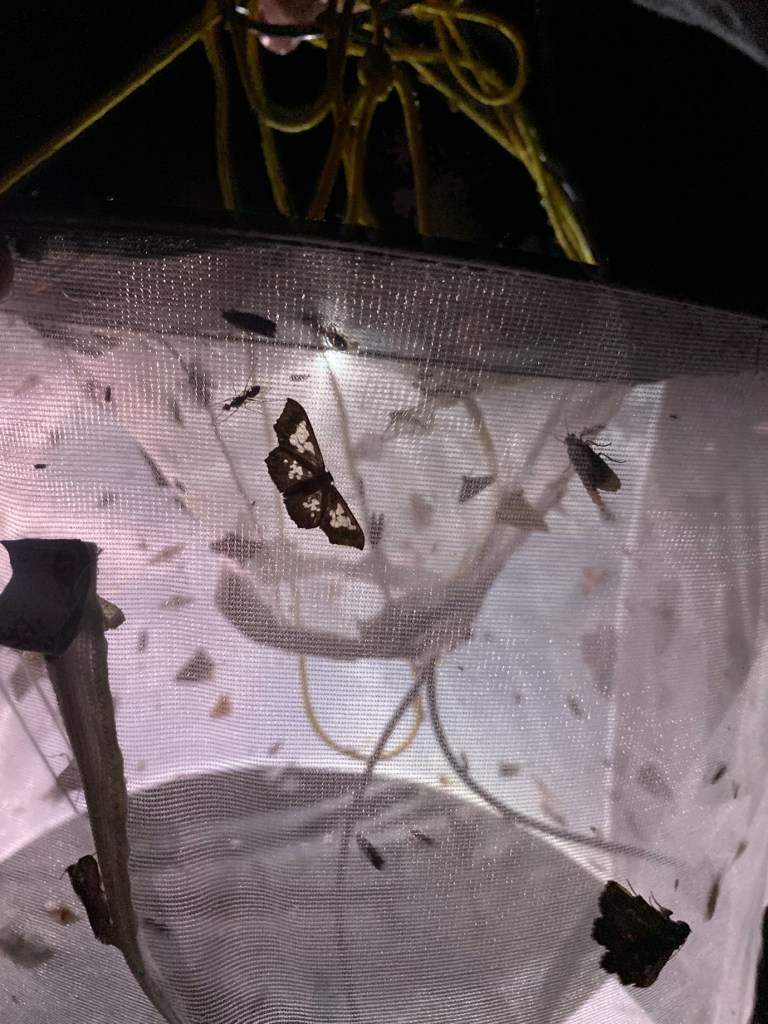
Image of one of the moth traps – we would have to capture and hold all these and take pictures for identifying – as you can imagine this could take 2-3 hours 😉 (Taken in Tobago in July 2024)
 The Neil Mackenzie Trust