
The Neil Mackenzie Trust is very excited to be assisting (in a small way) Claire Mellish (Tuppence) who is part of a team who will be attempting to be the first in history to cross the Northwest Passage on a rowing boat in a single season. This is one of the “last great firsts” on earth and we hope to be able to post updates, from her, during the course of the summer. The following is extracted from information we have received from her to date.
The Northwest Passage Expedition – The End of The Row, updated 2nd October
After making the decision to end the expedition at Cambridge Bay we had to wait at anchor for a few days for the right weather to allow us to get across Queen Maud Gulf to Cambridge Bay.
It was a little frustrating knowing we were so close to the finish (only about 25-30NM) and having to sit and wait for days but there were strong south easterly winds blowing and we wanted to make sure we could get across safely. We were all pretty good at waiting by now and continued our four hour on- four hour off anchor watch routine. The nights were quickly drawing in and we were getting around 10 hours of darkness. We did manage to sneak a little closer to Cambridge Bay on Thursday 14th and anchor in the shelter of the Macalpine Islands just off the coast. On Saturday 16th we were predicted to have a calmer day and just as were lifting our anchor in the morning to set off we received a hail on the VHF from Royal Canadian Coastguard Vessel Sir Wilfred Laurier. They informed us they were 5NM away and were putting their rapid response vessel in the water and would be with us in in 15-20 minutes. We told them that we weren’t in distress, but they asked us to sit tight and wait for them to arrive.
Upon arrival one of their crew came aboard Hermione and chatted to crew members to find out how we were all feeling and assess our physical state (we were all fine other than being tired and a little cold). The coastguard crew told us they had received a call from their HQ telling them we needed assistance (perhaps it was a concerned citizen, we aren’t totally sure). Since the coastguard had come all the way out to see us (thankfully they weren’t needed anywhere else at that time as the last thing we wanted was to take up search and rescue resources unnecessarily), they requested that we came with them onboard Sir Wilfred Laurier and that they would tow Hermione behind. In the end, however, it was decided that we five crew would go onboard the coastguard vessel with three (Leven, Livar and Davie) remaining on Hermione and Sir Wilfred Laurier and their RIB would escort Hermione (at her own speed) across the bay and into Cambridge Bay.
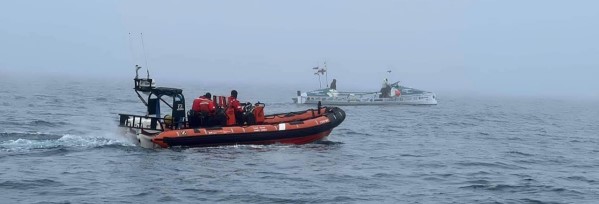
Coastguard Rib alongside Hermione
The wind died down as predicted but the fog rolled in reducing visibility to perhaps 20 or 30 metres. Hermione motored along under the power of the electric engine at around 5Kts, so we made good time getting into Cambridge Bay. On board Sir Wilfred Laurier five of the crew (me included) were treated to warm beef broth to warm us up and they kindly provided us with lunch. It was our first taste of hot fresh food since leaving Pond Inlet and was truly delicious. It was wonderful to get an insight into life on board a coastguard vessel and we met lots of interesting crew, including a Royal Naval officer who was there to learn about ice patrols before going aboard HMS Protector (the RN’s only ice patrol ship) in Antarctica. The medical officer spoke to us to assess that we were healthy and chatted to myself and Daniel, who is a doctor, about the medical kit we had on board and any issues the crew had been having (very few thankfully).
Once we reached the ranges just outside Cambridge Bay, we were taken ashore in the RIB so that we could go ahead and organise things for Hermione and find places for crew to stay. We said our thanks to the captain and crew of RCCG Sir Wilfred Laurier and I was delighted to be presented with a commemorative ship’s coin from them. The work that the coastguard and S&R teams do is invaluable, and we are so grateful to them for their quick response and how they dealt with the situation. Thankfully we weren’t in any distress, but the coastguard team were wonderful to deal with and we cannot thank them enough. Once back on dry land (a few of the crew had the wobbles whilst they adjusted to their legs walking on hard ground again) we were stopped by the RCMP who needed to see us about some paperwork. Due to the coastguard not knowing much about us when they collected us, they had to tell the RCMP they were bringing 8 people ashore to Canada. In small communities like Cambridge Bay there is no customs office and so it is up to the RCMP to complete all necessary immigration paperwork. We had to head to the station and explain that we had already cleared customs in Canada and hadn’t left it. Unfortunately, there was some confusion and immigration thought we had headed to Greenland and then back again. Eventually we sorted everything out and were also able to start making arrangements for the necessary paperwork that was required to keep Hermione in Canada over the winter. The RCMP were also brilliant and dealt with everything very efficiently and so we are also extremely grateful to them as well.

At Cambridge Bay
Once the remaining crew and Hermione arrived, we were able to grab our kit and head off to various hotels.

The last time on Hermione when she arrived in Cambridge Bay
Eventually I reached Toronto the following evening, via Vancouver and Kelowna and was thrilled to be reunited with family and friends. The expedition and the delivery trip were a once in a lifetime experience and even though there were many aspects that could have been different and things improved, it would not have been the experience that it was without all the low points as well as the highs. I would like to thank everyone who has supported me in whatever form. From sponsorship to messages of support I am touched by the overwhelming amount of kindness I have received. This expedition has undoubtedly changed me as a person. I have grown in ways I could never have imagined, and this is an experience that will remain with me forever. Until my next update I am going to enjoy some rest and relaxation in Canada for about a month, before flying back to Scotland. The warm weather in Southern Ontario is a mighty contrast from the near freezing temperatures of the Canadian Arctic. I am going to allow my frost-nipped fingers and toes to recover and am glad to be sleeping in real bed and getting to eat fresh food again. It was sad to say goodbye to the crew, but we are all bonded for life now and I hope to see some of them again very soon.
North West passage update – 15th September
‘It is with mixed emotions that I send this email. After battling winds so strong that we couldn’t steer properly and ended up making much of our progress by drifting sideways, rather than actually rowing forwards, we have anchored tucked in behind a small island at Cape Alexander. We have been waiting for the weather to improve to allow us to proceed. As the weather does not look favourable to allowing us to continue safely, after much discussion we have decided that we will be ending the expedition here are this time and will make an attempt to move back to Cambridge Bay where we will overwinter the boat and fly back home.
There may be the possibility of completing the rest of the journey next year. At this stage I can’t say whether I am able to be a part of this, but no matter what happens doing even half of the NWP feels like a huge achievement and I will be stepping away with my head held high, proud of my achievements and glad to be safe and sound.
This decision to stop was not made lightly but in the Arctic the one lesson that I have learnt is that you cannot underestimate the environment and have to consider all risks. We are getting later in the season and the temperature will only continue to fall. The darker nights make navigation both difficult and potentially dangerous. The combination of mixed currents and strong winds makes navigation extremely difficult and we have to avoid getting into a situation where we have no escape route and could end up run aground or smashed up on rocks.
I am incredibly proud of myself and the crew for what we have achieved so far. This journey has been a true once in a lifetime opportunity. I am so grateful to all of the people who have helped me get to the start line and to all the new friends and contacts we have met along the way, who have been kind, generous and many of whom have become firm friends.
The Arctic will forever hold a special place in my heart. It is a magical part of the world but not without its challenges. It can be beautiful and serene but also harsh and dangerous and should not be underestimated.
Our focus will now be getting to Cambridge Bay and then flying home. Once back on dry land, reunited with friend and family, and after a bit of time processing everything, I will post more about the entire experience and reflect on it all. For now though there may be only the odd update as I focus on getting back home and fitting back into normal life.
Thank you for all the support I have received and please do still donate to our charity “Siobhan’s Trust” (link can be found through the expedition social media pages) if you would like to express your support for myself, the crew and the expedition.
I will write again once we have landed at Cambridge Bay and worked out how to get home and what to do with the boat for the winter.
Kindest regards
Tuppence’
Expedition update – 9th September; report on the second week
We have completed the first week and start the second week on Day 8 Thursday 24th August sat at anchorage waiting for the wind to die down. Whilst here we have had a second sighting of a polar bear in the early hours of the morning.

The boys sitting on deck at anchorage
There is little that the crew can do when we are waiting at anchor than to sit patiently and wait for weather to allow us to continue our journey further south. Watch/shift routines have to be maintained and are changed to 4 hours rather the 2 hours when we are on the rowing deck.
In the early hours of the morning of Day 9 we had to reset our anchor as were dragging in the strong winds. It was a battle against the wind to get back to shore and the rough weather made it hard to grab the anchor rope. Once safely back close to shore and anchored and in the afternoon, we managed to make our way a little further south to the edge of the northern side of Cresswell Bay. We encountered a snowstorm, with thick flakes hitting us horizontally from our starboard side and eventually the wind was too strong to continue, so we anchored for the night until the weather improved.
On DAY 10- Saturday 26th August I was feeling rather tired and ill today, I think feeling the effects of the cold a bit. The wind direction changed to be more favourable at around 1pm and so we set off crossing Cresswell Bay and made good speed. We passed a magnificent iceberg as we got closer to land on the south side of Cresswell Bay. We anchored for the night further down the coast and managed to get a bit of sleep.
DAY 11- Sunday 27th August saw us arrive at Fort Ross, the last Hudson’s Bay Company trading post to be established. It was active from 1937-1948 and two of the old cabins remain. We beached the boat so we could come ashore and explore the cabins.
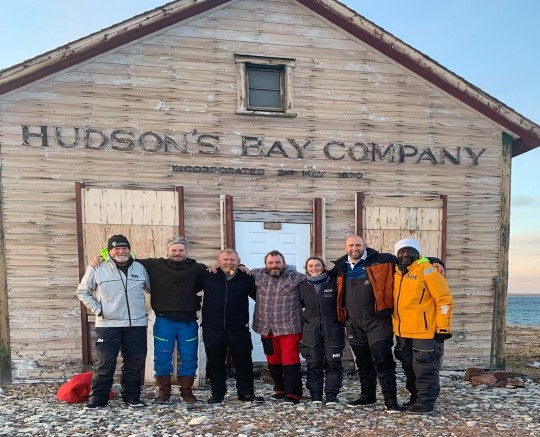
The crew outside the cabin at Fort Ross
We signed our names in the visitor’s book and had fun looking back at the previous visitors (spotting many familiar names from our fellow 2023 NWP crews). After a tiring day half of the boys slept in the cabins and the rest of us went back to the boat to sleep.
It is important for me to mention that on Sunday whilst battling strong winds just south of Cresswell Bay we broke a dagger board, this is not the end of the world but is certainly an inconvenience. It became apparent we weren’t going to be able to anchor again safely where we were and needed to get to a more sheltered location, the wind was very strong, and we would have been blown into a potentially dangerous situation and so the decision was made to advance to Fort Ross under the power of our electric motor. The very reason we kept the motor on board was for safety and so we are glad that has paid off as up here safety is paramount. The only real change is that at the end of this expedition we can’t make any claims to have been fully human powered throughout the passage, this has been a bit of a blow to the team. For myself this isn’t a major concern, being up here and rowing any distance in these areas is an achievement and I’m not up here doing this expedition to get a nice piece of paper with a world record on it (yes it might be a nice added bonus, but this expedition is about pushing myself and getting the opportunity to experience this truly unique and magical part of the world). So moving on, we keep rowing forwards, we learn from the past and we place our sights on making sure that however far through the passage we get, we ensure that we get there safely.
The next day – DAY 12- Monday 28th August we remained at Fort Ross, and it gave us a chance to rest up and explore this wonderful part of the Arctic. Since we aren’t leaving until Tuesday afternoon I spent the day exploring around the area. In the morning a polar bear was wandering down the hillside towards us, it got about 500m away and then stopped and sniffed and must have caught a whiff of us as it turned around and scarpered.
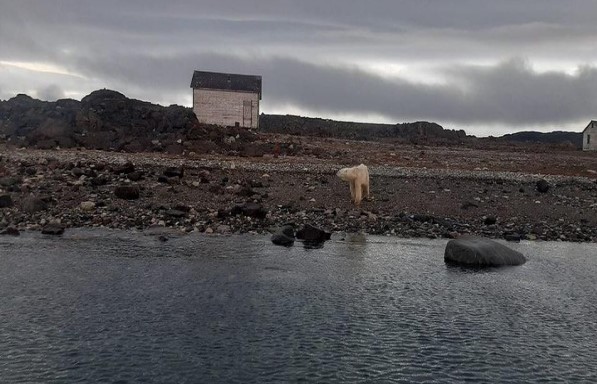
The polar bear between the cabin and the boat
Nothing much to report for day 14, just waiting for weather. There was a window of opportunity to have left in the evening with light Northerly winds throughout the night, but it was decided to wait for a potentially better weather window due to arrive Friday/ Saturday. Moving through the Arctic is about patience and waiting for the right weather windows, but at the same time pouncing when the opportunities occur. Even if only a small window exists, and you only move a small distance before having to anchor again and wait some more it is still important to move forwards whenever possible. Weather is unpredictable up here and the forecasts are often not accurate, so we often have to see if the weather window we are waiting for appears. Another serious lesson learnt is that you can never prepare enough for the conditions here. Prior planning and safety are of the utmost importance.
DAY 15- Wednesday 30th August was spent tidying the boat as we would not be leaving for a day or two. I took advantage of being off the boat and knowing we aren’t leaving for a bit to do some laundry, so that I can have a more frequent change of clean clothes (which will be a lovely treat). The boys found a huge sack of pancake mix and so I whisked up a batch of pancakes for a sort of brunch, which was just delicious. Whilst we have been at Fort Ross the crew took time to build a cairn and affix a plaque to it that Livar had brought with him.
The first of September started with being woken up by Davie alerting me to the fact there was a Polar bear on shore looking at us. It was very close to the boat, about 25m which was only just offshore, and it was moving closer quite quickly. We shouted at it and made some noise, and I radioed our shore team as well who had their deterrents at the ready. Eventually it did go away but it was a little close for comfort. It then lay down a 100m away and was there for a long time just lying. Finally, it moved on. It looked to be in very poor condition. At this time of year, they’re at their skinniest and I suspect it was an old bear that was desperate for food and that’s why it was trying to come towards the boat. We packed up the cabin and by 12:30pm we were on the move into Bellot Strait. It was a little sad to say goodbye to Fort Ross, but it is good to be on the move again and making progress.
Half-way through Bellot Strait we passed Zenith Point, on the northern edge of the Boothia Peninsula, which is the Northernmost point of mainland Canada and North America (located at 72°00’N, 94°39’W). Our evening has ended with silky calm seas, a beautiful sunset and a lovely moon shining down on us before disappearing behind the clouds. The wind completely died down this evening, but we are due to get a tail wind and some quite high speeds, so we shall see how that pans out, we may need to seek an anchorage to shelter for a bit.
This second week has been tough, but also pleasant with some questions being asked. We have noticed the temperature has dropped and been getting the odd snow shower, this means we have had to be more vigilant of the cold exposure to each individual as it can have serious effects to people’s judgement and thought processes. The days are shortening quite quickly, and the 24 hour daylight is slipping away fast and so there will be more rowing in darkness over the next stage of the expedition.
Update – 26th August; The Row has started – report on the first week
DAY 1- Thursday 17th August The crew had its final landside breakfast at the local hotel prior to setting off. Once we left the harbour the swell picked up and it was a bit of a battle all afternoon. We covered lots of ground though and are making progress. It’s been a bit of a baptism of fire for the crew, but everyone seems to be doing well. As I finished my shift, I was treated to seeing a beautiful bright red sun on our port side and a seal popping it’s head up to try and say hello every now and again.

Leaving Pond Inlet
DAY 2- Friday 18th August A slow day battling head winds as we tried to move north in Navy Board Inlet. We made up to the anchorage on the west side that we used on our way south. Tonight we are all sat on anchor watch, and the wind suddenly picked up a bit, so we hoped our anchor will continue to hold.
DAY 3- Saturday 19th August We were at our anchorage until 1pm and left with a South Easterly wind helping move us on our way up Navy Board. As we reached Tay Bay (where we first anchored when dropped off by Ugly Betty) we made the decision to keep going as the weather in Lancaster Sound looked good. During the day I took a couple of cast measurements for salinity with our CTD pod, for New York University. I also collected a piece of sea ice to melt and put in a bottle, which may hopefully be used for measuring microplastic levels.
DAY 4 & 5- Sunday 20th and Monday 21st August Today we could see Devon Island in the distance to the North as we slowly made our way along Lancaster Sound. The wind picked up and we had quite a swell with some biggish waves. We had a tail wind but the currents come from every direction so we didn’t pick up much extra speed. I am still finding the two hour shifts hard to adapt to, very hard to wake up, and then hard to get to sleep, hopefully I’ll adapt with time. It’s quite chilly and there has been a lot of fog which makes navigating much harder, as more concentration required, and there are no fixed points on the horizon to aim for.
DAY 6- Tuesday 22nd August Today we slowly turned down towards Prince Regent Inlet from Lancaster Sound and it has been very misty. Keeping morale up and passing the time on shifts with music, or Harry Potter audiobooks for all the crew. We are making our way across Prince Regent to get into the lee of the land on the west side, and then we will head south. The mist began to lift around mid-day and as we have slowly made our way south down Prince Regent inlet, we have been able to see the cliffs of Somerset Island. The last shift of the night was beautifully calm, with the sun glistening through the clouds and a couple of inquisitive seals coming nearby and following us for a bit. A few birds swooped down low and circled the boat a couple of times and the only noise to be heard now is the gentle splashing of the oars. It’s incredibly tranquil and a lovely end to the day.
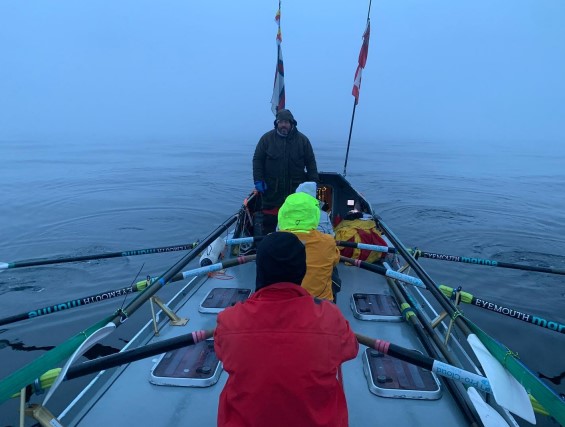
Rowing in the mist
DAY 7- Wednesday 23rd August Making our way down Prince Regent Inlet today, staying tucked in close to the shore of Somerset Island. The limestone cliffs of the island are quite impressive, with some bits looking like battlements of a castle complete with buttresses, and other bits looking like Easter Island statues sticking out of the rocksWe passed Batty Bay this morning, which is where the ship the Prince Albert overwintered for two years whilst searching for the lost Franklin expedition. We anchored at Fury Point until the wind died down a bit and we then plan to move further south. Being at anchorage is an opportunity for us to get a few extra hours rest (we switch from a two to a four hour shift pattern), as well as sorting kit and tidying things on the boat. Whilst on my rest period I was awoken by the boys on deck. Andy had spotted the first polar bear of our trip, walking along the shore towards us. They got polar bear deterrents ready, but it turned around as soon as they waved their arms and said, “go away bear”.
Update – 26th August; final part of the delivery trip
The final part of the delivery expedition was crossing Baffin Bay from Greenland to Canada.

The journey across Baffin Bay
Originally our plans were to head across from high up on the west coast of Greenland, but as the weather was not looking good, we headed back south towards Upernavik with the MV Ugly Betty towing us as it would not be safe to make the crossing with the forecast of 30kt winds.
The plan was to reach Tay Bay which is down Navy Board Inlet, on the west side of Bylot Island and then we would part company with the MV Ugly Betty at this point. After cruising through fog, we had our first sighting of Canada as we entered Navy Board Inlet. What a journey it has been so far. Only about 100NM to go before we reach Pond Inlet and the start of our rowing expedition.
On Wednesday 9th August the sea was pretty choppy and there was lots of fog. As we approached Bylot it was pretty foggy, and we had a very unlucky collision with a bergy bit. Hermione got a dent on her port side but not too much damage done. The evening was gorgeous as we arrived at Tay Bay and this was where we had to say goodbye to The Uglies. After anchoring we had a celebratory glass of bubbly for making it to Canada and then started on our usual 4 hour watch shifts.
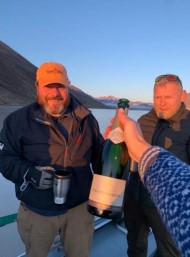
Celebratory glass of bubbly
Now that we are under our own power again, we waited at the top of Navy Board Inlet in Tay Bay to allow the conditions to improve. We headed south and then decided to try and cut to the west shore of Navy Board, as that is where there was less ice on the charts. Unfortunately, we had some wind being funnelled down Navy Board, which usually would have been a lovely tail wind but made it harder to manoeuvre through ice. We persevered for a bit but didn’t like the conditions so headed back to the East Side and decided to anchor for the evening. It was a truly beautiful spot yet again and we saw a couple of Bowhead whales and some seals whilst on anchor watch. The sea began to freeze in a thin layer in places, which was mesmerising to watch little frozen circles of ice drift past. In the afternoon we were hailed by SY Ocean View, which had anchored in Tay Bay the previous night. Saturday 12th August was just an overall fantastic day and I have climbed into the cabin after my last watch shift smiling after such an enjoyable day.
We finally made it to Pond Inlet on Sunday 13th August – having set off just before 4am with beautiful calm seas. There was very little ice, and it was easily navigable. A very pleasant morning.
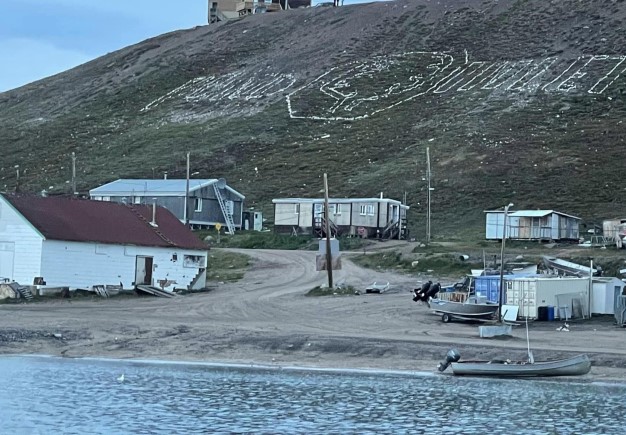
Pond inlet
After waking for my next shift at around midday it was pretty choppy and we were very close to meeting up with Marie Tharp, a research vessel which had agreed to help meet up with us. Timing couldn’t have been better as the rougher seas seemed to be causing the engine fault to glitch more and so we were fighting a battle against the wind with trying to make progress and steer whilst our engine kept cutting out. Marie Tharp threw us a line that we attached to our bow line and then they set up a bridle to tow us behind. Given the conditions we opted not to go aboard their boat as bringing Hermione alongside would have likely caused some damage. We kept steering whilst they towed us, which was a bit of a battle with the weather as well. Monday 14th August was our first day on Canadian soil. We had a bit of time together as a team just to catch up and made some plans for the next few days. Our boat attracted a lot of attention from the local kids and we had a lot of fun having them on board playing around the boat.

Local children helping us load the boat
We spent another day of organising the boat, fitting the new electric engine (for emergencies if required) and packing things like the medical kit.
Update – 17th August; the row has started!
Just a quick update today to say that the team left Pond Inlet today and have started their attempt to row the North West passage. Further info on the final part of the delivery trip and the first part of the actual expedition will follow shortly.
Update – 2nd August; delivery trip progress – highlights

Hermione and Ugly Betty moored together


Some of the icebergs seen
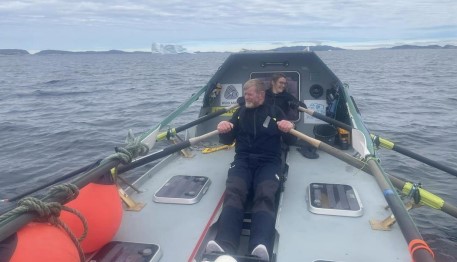
Rowing Hermione for the first time in the Arctic with Davie
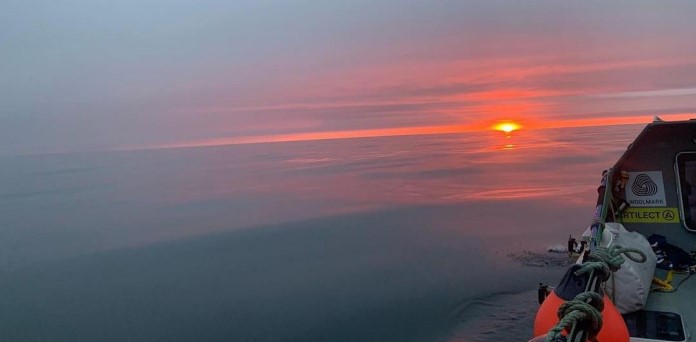
Sunrise through the fog
Update – 2nd July
This is an update about the NWP expedition’s first few weeks covering our trip from launching the boat in Eyemouth to leaving Iceland.
I have been away for just over three weeks now, admittedly only four or so days has been at sea, but it’s been a brilliant experience. We set off from Eyemouth Harbour on the evening of Thursday 8th June having spent the day doing final preparations and checks.

Leaving Eyemouth Harbour
On our journey from Eyemouth to Orkney I got to get a good feel for the workings of the boat and really worked some muscles trying to steer our course in some strong winds and choppy weather. Watching out for offshore wind farms, boats and lobster pots was also a good way of staying alert.
We had a great few days in Orkney, and I loved meeting some truly wonderful people, from all over the world who were interested in our trip, and it was great to hear their stories as well. Whilst in Orkney, we also met Maiwenn Beadle, who has crossed the passage before, and she gave us some wonderful advice about our weather routing and passage plans. Radio Orkney also did an interview with us and this can be found on BBC Sounds https://www.bbc.co.uk/sounds/play/m001mw7p (24.3mins into the programme is when the interview starts).

Members of Orkney Rowing Club paying a visit to Hermione
Our next leg was to get to The Faroes, and we had beautiful calm waters, but lots of fog. We made great time, as we expected to take maybe 3 or 4 days and did it in just over 2 days. The fog made spotting vessels hard, even with the AIS alerting us to their presence, we couldn’t see ships until they were almost next to us, and so we had a couple of close calls with a tanker and also a pair of fishing trawlers, but thankfully all collisions were avoided, and we made it to Hvannasund safely.
There looked as if there were going to be some strong winds as we approached Iceland and we were concerned about manoeuvring Hermione into port, as she doesn’t turn well with the engine, our options were to sit and wait for the weather to pass, meaning arriving in Iceland later than planned, or possibly to get a lift on a bigger boat. Last year we had been offered a sponsored lift on a container boat to Iceland by cargo ship and so Livar approached them again and they were thrilled to help us out. We then set about making a cradle to support Hermione and a couple of days ago we motored her out of Hvannasund and into Torshavn to have her lifted out of the water and onto a bigger boat.
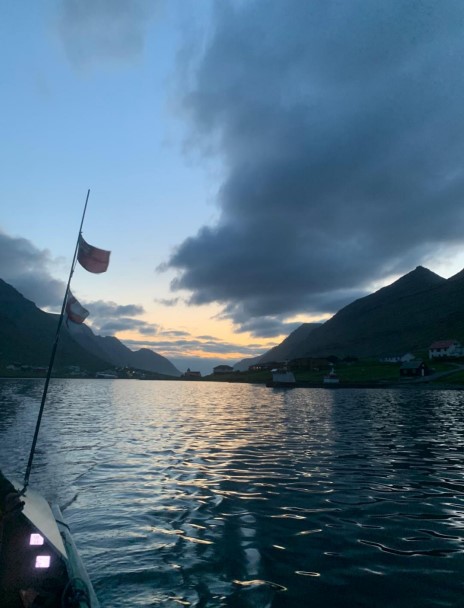
Motoring late in the evening to the other side of Faroe
With Hermoine safely loaded on a Cargo Ship we spent the next couple of days sight seeing on Faroe and enjoying the island’s hospitality which included celebrating Livar’s local village team winning at the rowing regatta. To get to Iceland Levan and I hopped on a plane and were met in Reykjavík by the crew of MV Ugly Betty who have kindly taken us under their wing and provided us with accommodation whilst we are in Iceland.
The next leg of the journey will be very exciting as we are to be towed by the MV Ugly Betty. So, we have had a run through of the safety protocols that the MV Ugly Betty have and worked out how we are going to attach and manage the towing of our boat behind MV Ugly Betty. So, we have just left Reykjavik and head towards Greenland, hopefully the trip will take about 6 days to reach Neuk, our progress can be tracked on the tracker that is on our expedition website. https://nwpexpedition.com/tracking/
The first two weeks have been amazing, and a brilliant experience. The best part has been all the wonderful and kind people we have met on the way, and I already know I have formed some fab new friendships, which is so exciting.
Update – posted 6th June

Although it might not seem like it things have been very busy behind the scenes and I am thrilled to announce that if all things go smoothly we will be setting off on the first stage of our delivery expedition this week (hopefully on Thursday evening).
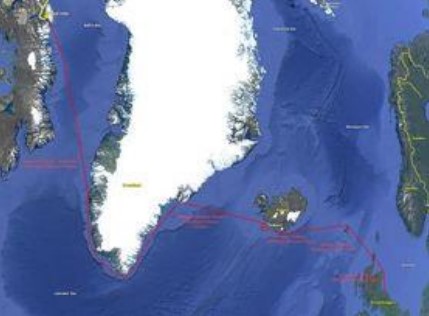
The red line highlights our planned delivery route.
The delivery expedition will involve moving the boat from Eyemouth all the way to Pond Inlet. There will be two of us as crew for the whole journey (myself and expedition leader Leven Brown), with others joining us for shorter legs throughout. We will be moving our boat (Hermione) using an electric hybrid outboard engine supplied by E-Propulsion. Our journey will take us to Orkney, Faroe Islands, Iceland and Greenland before finally reaching Pond Inlet. We estimate the journey will take around 45 days and will be hoping to update you all as we go.
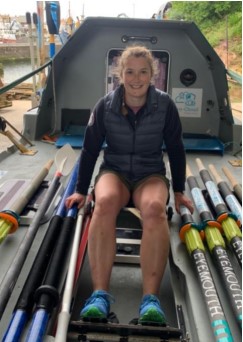
With not long left until we depart, the final preparations include repacking kit to make sure we have everything, packing our rations into bags for each person per day, as well as thoroughly enjoying the last few weeks that will be spent with the luxuries of fresh food, indoor plumbing and a comfy bed.
Posted 5th May
“As a young woman in a difficult profession who has recently spent most of their time focussing on books and studying, rather than the outdoors and adventure, I want to use my experiences from this expedition to help positively influence other young individuals, especially women, to get outside and get exploring. I want to also be able show others that when you put your mind to something you really can reach your goals, no matter how unattainable they may seem at first.”
THE ROUTE
The NWP is the route that connects the Atlantic and Pacific oceans between Canada and Alaska. The team will start their expedition at Pond Inlet on Baffin Island and intend to finish at Port Barrow in Alaska.
The search for a sea route through the NWP began during the 15th century with European explorers trying to find a trade route through to Asia. Many famous explorers such as Captain Cook and Sir John Franklin attempted to complete the passage but were unsuccessful. In 1906 Roald Amusden became the first to navigate the passage successful by ship. There have been several previous attempts to row the NWP but so far none have been successful.
THE ENVIRONMENT
The sad reality is that this expedition is only possible because of the retreating ice in the Arctic Ocean. As a team we are going to use our experiences to document and highlight the affects of climate change in Arctic regions. We will be collecting data, for research into micro-plastics, in partnership with New York University and Big Blue Ocean Cleanup. The team will be unbiased in their approach to data collection and we will be reporting the facts as we see them.
Throughout the row the team will encounter many risks and difficulties including icebergs, strong winds and rough waves and potentially polar bears. Preparation is key and as a team we have all been working hard to ensure we are both physically and mentally prepared for the expedition.
As a team we want the NWP expedition to be about so much more than our efforts to cross the passage. We want to use our experiences from this expedition and the media attention gained to be able to highlight the effects of climate change and micro-plastics in Arctic environments. We also want to encourage individuals from all walks of life to get outside and get exploring, but also to take care of our oceans and be aware of the importance of ocean conservation.
We want our expedition to have a focus on sustainability and environmental responsibility and so wherever possible we are hoping to have as little environmental impact as possible.

PREPARATIONS
Preparations are ramping up now, with only a few weeks until the delivery of the boat to Canada begins. I am going to be a part of this expedition, which will see us using an electric outboard motor, rowing and possibly a small sail to manoeuvre our boat from Eyemouth to Orkney, then Faroe, then Iceland, then round the coast of Greenland, and eventually across the Davies Strait to Baffin Island. Our plan is to set off around the 15th May, although this may vary based on weather conditions. I hope that at each of our stops I will be able to provide some photographs and updates. We will be all based up in Pond Inlet, Baffin Island from late June/ early July and are expecting to leave around mid-late July (again weather is a major factor here).

Our first sea trials this week (27/4/23) involved getting our boat (Hermione) into the water and then we wanted to test out our outboard for the delivery expedition, and it was great to see how well it did. We also got rowing practice in, and found that we rowed very well together, despite massive size differences (myself being the smallest at 5ft 4.5 and the tallest being about 6ft 4), meaning our stroke lengths aren’t always easy to match but we were able to find a stroke that suited everyone. I will admit to feeling pretty sea sick on the voyage, as the boat is long and narrow and has a very particular way of moving in the water that takes a while to get used to. However, I will be taking medication in advance next time, and am convinced it is more of a mental battle whilst my body adapts to its new environment.


